This devotional is AI-adapted from our Stripped Series of teachings.
“There is no fear in love. But perfect love drives out fear, because fear has to do with punishment. The one who fears is not made perfect in love.” – 1 John 4:18
Life can feel overwhelming. The world around us seems filled with division, hatred, fear, and uncertainty. Maybe you’re facing anxieties about your health, your family, your future, or even your salvation. Perhaps old habits and feelings of unworthiness cling to you, whispering doubts and fears into your heart. Remember, friend, you are not alone in this struggle.
In Zechariah 3:1-5, we see a powerful image of being cleansed and clothed anew. Like Joshua the high priest, we too can come before God, acknowledging our imperfections and receiving His grace. For God so loved the world, He sent his only Son to change our eternity. Jesus took on our burdens, our anxieties, and our fears. He was “stripped” of everything, even life itself, so that we could be “clothed in Christ’s Righteousness.” Believe that Jesus stripped away the sting of death and the penalty of sin, and that you have been made clean through His sacrifice.
Trust Him. Let go of control. Don’t allow the fear of the things of the world to cause you to clench up and try to grab hold tighter. He is sovereign, even over the powers that cause fear. Allow His perfect love to cast out your anxieties, replacing them with a peace that surpasses understanding.
Surrendering Your Fears Take some time to reflect on the following questions. Be honest with yourself and with God, trusting that He is listening with compassion and understanding.
What specific anxieties are weighing heavily on your heart today? Write them down.
Can you identify any “old garments” of shame, guilt, or past failures that you are still clinging to? Consider how accepting “your new identity in Christ” will make things new.
How can you actively “cast off your anxieties and cares” and trust in God’s plan for your life, knowing that He has already overcome the world for you?
What practical steps can you take this week to “live in the new garments that Christ has given you” – forgiveness, righteousness, and secure salvation? Consider focusing on prayer and Bible study.
Father God, I come before You today, acknowledging my anxieties and fears. I confess that I often try to control situations and worry about things beyond my control. Forgive me for not trusting in Your perfect plan for my life. I choose to surrender my anxieties to You now, knowing that You are sovereign over all things. Help me to feel the breakthrough and relief of having the weight of my worries lifted. Clothe me in Christ’s righteousness, fill me with Your peace, and empower me to live a life free from fear. In Jesus’ name, Amen.
Part 5 of the Lenten “Stripped” Series (Blog created with the help of AI)
As I look around at today’s headlines—new tariffs against allied nations, ongoing conflicts in Ukraine, Germany preparing for potential war with Russia—it’s easy to feel overwhelmed by the powers that seem to control our world. Perhaps you feel it too: that sense of powerlessness in the face of global politics, economic forces, or even personal struggles against spiritual darkness.
But what if I told you these powers have already been defeated?
The Powers That Seemed Undefeatable
When Jesus walked the earth, He faced opposition from the most formidable powers of His day:
The Religious Authorities: The Sanhedrin, guardians of Jewish law and tradition, saw Jesus as a threat to their carefully maintained religious system. They were willing to condemn an innocent man to protect their position.
The Roman Empire: The most powerful political force in the world used its might to scourge, mock, and ultimately crucify Jesus. Rome’s message was clear: challenge our authority, and this is what happens.
Behind these visible, earthly powers operated something more sinister. As Paul reminds us in Ephesians 6:12, “We do not wrestle against flesh and blood, but against the rulers, against the authorities, against the cosmic powers over this present darkness, against the spiritual forces of evil in the heavenly places.”
These spiritual forces recognized Jesus (Mark 1:24) but misunderstood God’s plan. They believed killing the Messiah would derail salvation. As Paul writes in 1 Corinthians 2:8, “None of the rulers of this age understood this, for if they had, they would not have crucified the Lord of glory.”
The Great Reversal at the Cross
What appeared to be Jesus’ moment of ultimate defeat was actually His triumph. The cross—an instrument of shame and torture—became the very means by which Christ stripped these powers of their authority.
Colossians 2:15 puts it powerfully: “He disarmed the rulers and authorities and put them to open shame, by triumphing over them in him.”
The Greek word translated “disarmed” literally means “to strip off completely,” like removing armor from a defeated foe. Through His apparent weakness, Christ exposed the true powerlessness of every authority that sets itself against God’s kingdom.
This is the great paradox of the cross: what looked like defeat was actually victory. What seemed like shame became glory. What appeared to be weakness revealed itself as the greatest power in the universe—the power of God’s self-giving love.
Living in Christ’s Victory, Not Fear
So what does this mean for us today?
When we watch the news and feel anxiety rising, when political leaders make troubling decisions, when economic uncertainties loom, or when we sense spiritual opposition in our personal lives—we have a choice. We can either live in fear of these powers, or we can live from Christ’s victory over them.
Here’s what living from victory looks like:
1. We Stand in Freedom, Not Fear
If Christ has already disarmed the powers, we need not cower before them. No law, leader, or spiritual force can separate us from God’s love (Romans 8:38-39). As Paul reminds us, “Thanks be to God, who gives us the victory through our Lord Jesus Christ” (1 Corinthians 15:57). Even death itself—that final enemy—has lost its sting.
2. We Practice Humble Confidence
James 4:7 instructs us to “Resist the devil, and he will flee from you.” Because Christ has already won the decisive battle, we can stand firm against evil with confidence—not in ourselves, but in His finished work.
This confidence isn’t arrogance. It’s balanced by humility, recognizing that the victory belongs to Christ, not us. We depend entirely on Him while boldly living out the implications of His triumph.
3. We See Through the Illusion of Ultimate Power
When earthly authorities claim absolute power, we see through the facade. We know what the “rulers of this age” don’t: that Christ has exposed their claims as empty. No president, dictator, economic system, or spiritual force holds ultimate authority. “The kingdoms of this world have become the kingdoms of our Lord and of His Christ” (Revelation 11:15).
Practical Steps for Reclaiming Christ’s Victory
How do we live this out practically in a world that still seems dominated by these powers?
First, resist fear. When you see disturbing headlines or feel intimidated by authorities, remember who sits on the ultimate throne. Their apparent power is temporary; Christ’s victory is eternal.
Second, stand firm in spiritual warfare. Put on the full armor of God (Ephesians 6:10-18). Use Scripture, prayer, and Christian fellowship as your defense against spiritual attacks.
Third, remove the victim mindset. You are not ultimately subject to the powers of this world. In Christ, you are already seated “in the heavenly places” (Ephesians 2:6), far above every other authority.
Finally, live boldly. The early Christians turned the world upside down despite facing opposition from both religious and political powers. They understood what we often forget: that the cross has already stripped these powers of their ultimate authority.
This Lenten Season
As we continue our Lenten journey toward Easter, let the cross remind you that no force—political, spiritual, or personal—can usurp the Lord’s reign. The powers have been stripped. Christ has triumphed. And we get to live in that victory.
Where O death is your victory? Where O death is your sting? Even death—that ultimate power—has no hold over us, for “death is swallowed up in victory” (1 Corinthians 15:54).
This week, I challenge you: identify one area where you’ve been living in fear of earthly or spiritual powers. How would your approach change if you truly believed Christ had already disarmed that power? Take one bold step to live from His victory rather than toward it.
This post is part of our Lenten “Stripped” series, exploring how Christ strips away everything that separates us from experiencing God’s redemptive work. Previous posts examined how God strips us of pride, purifies us from hidden sin, removes our old self, and how Christ Himself was stripped in humiliation for our sake.
Join us next week as we explore the final theme in our series: “Stripped for Restoration.”
I read an Oswald Chambers devotional this morning—someone in our community shared the link to yesterday’s entry, so I decided to check out today’s post as well. You can find it here: “Is He Really Lord?”. Some of the highlights from that devotional really resonated with me.
I can get caught up in the whole “content creator” mindset, thinking about growing my numbers or making an income. But first and foremost, I have a church—a small flock—to care for, and that’s the ministry God gave me. I’m not a content creator first; I’m a pastor first. So I need to be cautious about anything I add to my plate. Oswald Chambers says, “Have I received a ministry from the Lord? If so, I have to be loyal to it. I have to count my life precious only for its fulfillment.”
Second, our ministry (or calling) comes from staying connected to the Vine. Chambers points out, “We must get to know Jesus as more than our personal savior; we must know him as an intimate companion. Only then will he reveal to us our purpose.” That challenges me to spend time with Him, rather than pouring all my energy into content creation, gaining followers, and so on.
This part really struck me: “Do you love me?” Jesus asked Peter. “Feed my sheep” (John 21:17). Notice that Jesus doesn’t give us a choice about how to serve. That realization hits hard. In both my day-to-day career and my ministry work, I see that His call is a command. It’s not up for negotiation. It’s about doing what He’s purposed for me to do.
Chambers also says, “But the need isn’t what’s calling us; the need is simply an opportunity for answering the call. The call itself is a call to absolute loyalty.” We can become so wrapped up in audience numbers, a bigger church, or an income that we lose sight of our real call. If God’s calling us to share the Gospel with whoever He puts in front of us, we need to focus on that. Everything else is a distraction.
I know my purpose and calling is to minister His Word. It’s not about picking and choosing a flock, recruiting more followers, or doing something that might personally fulfill someone else. I need to watch out for demands and distractions that pull me away from my God-given purpose. As Oswald Chambers ends: “It does mean that you will have to ignore the demands for service along other lines.”
May we all remain faithful to the unique calling God has placed on our lives, staying connected to Him and loyal to the work He’s entrusted to us.
Reflection Questions
Which distractions or demands are most likely to pull you away from God’s calling in your life?
How can you intentionally nurture your relationship with Jesus—beyond simply knowing Him as Savior—so you’re fully connected to the Vine?
In what practical ways can you remain loyal to the ministry or purpose God has given you, even when it conflicts with other enticing opportunities?
Did you get into the “Left Behind” series or other “end times” fiction like that back in the day? It was honestly what helped me come back to the Lord. I’ve been thinking about it and decided to review some of it again.
In dispensationalist theology, (which is what a lot of end-times fiction is built on), these are some the ideas proposed concerning the “Anti-Christ.”
1. The Antichrist is often portrayed as a cunning, charismatic political figure who rises to global prominence, often associated with a “revived Roman Empire.” Some dispensationalists say this could be Russia.
2. He is said to broker or confirm a seven-year peace deal involving Israel. Daniel 9:27. So, he will appear as a “peaceful” “savior-like” individual with the power to convince the nations he is good for Israel.
3. Halfway through that 7-year period (at 3.5 years), the Antichrist breaks the treaty. Daniel 9:27 again. (During the first half the Temple is rebuilt and sacrifices begin until he ends them during the second period…the second half of the “Tribulation Period“).
4. He suffers a fatal head wound per Revelation 13:3, that leads many to follow him.
5. After his “resurrection” from this fatal wound, he and his false prophet will “demand” or receive the world’s worship.
6. The mark of the beast will be instituted, possibly a type of currency, that will be required world-wide.
I’m not a full-hearted dispensationalist, but I do fear, that IF the anti-Christ were to appear today, it would be a large population of Christians and Jews that would fall for him. Why? Because he would appear to be on “our side” in the beginning. This is his deception.
The good news is that, In the end, the true children of Christ will be victorious, through Christ alone.
There will be a Second coming of Christ. He will overcome the Adversary and any “little-horn” that aligns with him. Revelation 19:20.
My cry to you, and the world, is to make sure you have truly given your life to Christ. Not just, “I believe in Jesus,” as “even the demons believe and shudder,” (James 2:19). Saving belief, means to trust in His work on the Cross. To believe means, He is the Lord of your life, for we were purchased by His blood. And if He is Lord and Savior of you and I then we shall strive to live for Him as best we can every day… producing fruits of the Holy Spirit to prove our salvation is true. (This is a work of the Spirit, not our own effort, He causes us to produce the fruits of the Spirit).
If all of this is scary, Jesus reminds us to “Take heart! I have overcome the world!” John 16:33
Revelation 22:20-21 He who testifies to these things says, “Yes, I am coming soon.” Amen. Come, Lord Jesus. The grace of the Lord Jesus be with God’s people. Amen.
Everything above is not all biblical facts, but instead is a lot of “interpretation.”
Just as a toolbox contains various instruments designed for specific purposes, the church is filled with individuals gifted by God for particular roles. Remember, God has created us and has given us certain gifts and abilities for a purpose, and that purpose even fits into your personal circumstances.
Consider the analogy of tools:
A flathead screwdriver works best for its intended purpose
A ratchet is designed for a specific size nut
A hammer excels at driving nails but struggles with screws
Similarly, each of us has been crafted by our Creator with unique spiritual gifts that are essential for the functioning of the church as a whole.
Discovering Your Spiritual Gifts
Scripture tells us that “there are varieties of gifts, but the same Spirit”. Some of these gifts include:
Wisdom
Knowledge
Faith
Healing
Miracles
Prophecy
Discernment
Speaking in tongues
Interpretation of tongues
It’s important to remember that no single person possesses all these gifts. Instead, we are designed to work together, complementing one another’s abilities to form a complete and effective body of Christ.
Embracing Your Purpose in Every Season
You might be wondering, “How can I use my gifts if I’m stuck at home or facing limiting circumstances?” The beauty of spiritual gifts is that they are not bound by physical limitations.
Here are some ways to embrace and utilize your spiritual gifts, even in challenging situations:
Prayer and Intercession: Use the gift of faith to pray for others and support the church from wherever you are.
Online Ministry: Leverage technology to share wisdom, knowledge, or encouragement through social media, blogs, or virtual Bible studies.
Encouragement: Send messages, cards, or make phone calls to uplift fellow believers using your gift of exhortation.
Creative Arts: Use talents in writing, music, or visual arts to create content that inspires and teaches others about God’s love.
Virtual Hospitality: Host online gatherings or one-on-one video chats to foster community and connection.
Conclusion: You Are Made for This
Remember, God created you for a purpose, and He has empowered you with specific gifts to do so. Your circumstances do not define your ability to serve. Instead, they provide a unique context for your gifts to shine.
As you seek to discover and use your spiritual gifts, remember that you are an essential part of the body of Christ. Your contributions, no matter how small they may seem, are vital to the church’s overall health and mission.
So, embrace your God-given purpose, seek out opportunities to serve, and trust that the Holy Spirit will empower you to make a difference – right where you are. After all, you were made for this!
This post has been generated with the help of AI, reflecting on the themes and teachings from my recent sermon.
Today I’d like to share some insights from a recent sermon I shared with Innovate Church on April 28, 2024. Let’s explore together the deep questions about our spiritual journey and the answers that can guide us toward a life of righteousness.
What does it mean to truly hunger and thirst for righteousness?
To “hunger and thirst for righteousness” means feeling a profound, persistent desire to align one’s life with God’s will. Imagine the deepest physical hunger or thirst you’ve experienced; this is how our spirit feels about righteousness. Matthew 5:6 from the Beatitudes promises us that such spiritual longings will be satisfied. This beatitude emphasizes the necessity of recognizing our spiritual emptiness and the need to fill it with divine presence and guidance.
How do the previous Beatitudes prepare us for this hunger and thirst?
The earlier Beatitudes set the stage for a true craving for righteousness. Being “poor in spirit” means acknowledging our complete dependence on God, devoid of spiritual pride. Mourning our sins leads to a repentant heart, while meekness cultivates humility—essential steps before we can earnestly seek righteousness. These spiritual conditions prime our hearts to receive and cherish the divine righteousness that God alone can provide.
What are practical steps to cultivate a life that hungers and thirsts for righteousness?
Cultivating such a life involves deliberate spiritual disciplines. Just as one might clean unhealthy foods out of their fridge to improve physical health, we must also clear our lives of spiritual impediments. Replacing them with regular prayer, meditation, Scripture study, and engaging in community with fellow believers are essential practices. These habits help us fill the void left by worldly desires with something infinitely more nourishing.
How do we maintain our spiritual health and hunger in times of temptation and challenge?
Maintaining spiritual health, especially during challenges, requires resilience and continuous spiritual nourishment. Analogous to dieting, where one might switch to healthier food options, our spiritual life also demands regular attention and adjustment. Temptations are like the unhealthy snacks that tempt us; we must consciously choose to reject them and replace them with wholesome spiritual practices.
How can we support each other in our quest for righteousness?
Communal support is crucial in our spiritual journey. Like athletes who benefit from the encouragement of coaches and fans, we thrive spiritually within a supportive community. In our church, we foster an environment where members can share their struggles and victories, providing encouragement and accountability. This communal support is vital for nurturing our spiritual growth and perseverance.
What is the ultimate promise for those who pursue this path?
The ultimate promise for those diligently seeking righteousness is profound peace and fulfillment—far surpassing temporary earthly pleasures. “Blessed are those who hunger and thirst for righteousness, for they shall be satisfied.” This divine assurance promises enduring fulfillment and a closer alignment with God’s purpose for our lives.
Thank you for joining me in reflecting on these spiritual truths. As we continue to seek God’s righteousness, let us support one another and share the joy of a life that is truly satisfied in Christ.
Find Support in Your Spiritual Journey
Don’t walk the Spiritual journey alone. Walk it with us. Let us encourage and spur you on to good works. We have a Discord community where we connect and encourage each other throughout the week we’d love you to join. There you can also keep up with our live church online activities like our Thursday night Zoom Bible studies and Sunday livestream church services. Won’t you join us?
Blog post adapted from my sermon transcript on Jesus’s “I Am the Resurrection and the Life” statement using AI.
Have you ever felt completely alone in your pain and suffering? Like no one understands what you’re going through? The loneliness and isolation can feel suffocating at times.
I want you to know that you are not alone. There is a community of people who have been where you are. And more importantly, there is a Savior named Jesus who intimately understands your suffering. He promises never to leave or forsake you.
The Weight of Loneliness In the Gospel of John, we read about two sisters named Mary and Martha who were dealing with overwhelming grief after the death of their brother Lazarus. They sent word to Jesus that the one he loved was ill, surely hoping he would come quickly. But Jesus delayed. By the time he arrived, Lazarus had been dead four days.
Mary and Martha must have felt so alone in their mourning. Where was Jesus, whom they thought of as a friend? Why did he take so long to come? The sting of death was bad enough without feeling abandoned too.
Maybe you can relate to those feelings of isolation and abandonment that Mary and Martha experienced. A loved one gone. Prayers that seem to go unanswered. An all-consuming sadness. You cry out, “God, why have you left me alone in this pit of darkness?”
The Truth of His Presence But here’s the truth – you are not alone. Not ever. Jesus made an astounding claim to Martha that day at the tomb of Lazarus. He said, “I am the resurrection and the life. Whoever believes in me, though he die, yet shall he live.”
Jesus was letting Martha know that He has power over death itself. Death is not the end. And He is intimately present with us, even in our darkest valleys. He does not just observe our suffering from a distance. He weeps with us (John 11:35). He understands our anguish in a profound way.
In fact, Jesus experienced the ultimate loneliness and isolation when he took on the sins of the world. On the cross, he was forsaken by the Father so that we would never have to be separated from God’s love. Jesus became sin itself so that we could be made right with God (2 Corinthians 5:21). He drank the cup of God’s wrath over sin so that we could drink the cup of acceptance as children of God.
Purpose in the Pain Not only does Jesus intimately experience our suffering with us, He has an eternal purpose for allowing it. The Bible tells us that our present sufferings “are not worth comparing with the glory that is going to be revealed to us” (Romans 8:18). Our momentary afflictions are “preparing for us an eternal weight of glory beyond all comparison” (2 Corinthians 4:17).
Jesus demonstrated this when he intentionally delayed going to Lazarus so that God’s power could be displayed in raising him from the dead. Your pain may seem purposeless now. But Jesus promises that He will use it to accomplish something of eternal significance, if you trust Him. Your suffering is never wasted in His hands.
An Invitation to Belong Not only do you never have to feel alone in your trials, you are invited into a loving community of people who will weep with you, pray with you, and carry your burdens. Church is not just a building or an organization – it is a spiritual family.
As the sermon said, “You are not to be a Christian out there living the faith alone. You’re part of the body. You need to be reattached with the body…We will take you in if you’re a lone Christian out there looking for family, or even if you’re not even Christian yet, you’re just kind of interested or curious. We’ll welcome you.”
You belong. You are wanted. You are loved, despite your failures and shortcomings. The arms of this spiritual family are open wide to embrace you.
An Eternal Hope Jesus does not abandon his people to the grave. When he resurrected Lazarus, it foreshadowed His own bodily resurrection three days after his death on a cross. By conquering death, Jesus has secured eternal life for all who put their faith in Him.
“As he declared, “Whoever lives and believes in me shall never die” (John 11:26). Physical death is merely a temporary sleep. For those who put their faith in Jesus as the resurrection and the life, physical death is just a passing from this life into eternal life with Him.
Jesus said, “I am the resurrection and the life. The one who believes in me will live, even though they die” (John 11:25). Our earthly bodies may die, but we will be resurrected into new, imperishable bodies to live forever with Christ. Death is swallowed up in victory (1 Corinthians 15:54)!
So you see, even when walking through the darkest valley of suffering and death, we never have to fear. We can take comfort that Jesus has triumphed over sin, death, loneliness and pain. By His resurrection, He has secured for us eternal life and the promise to wipe away every tear from our eyes (Revelation 21:4). Our suffering now is temporary; eternal joy awaits for those who put their hope in the risen Savior.”
I previously touched on not pushing a move from YouTube to Twitch. Now, I’m spinning the narrative a bit because I’m all in on getting us onto Discord. Here’s the scoop on why and how.
Being a digital-only church means we lack a physical space. No building, no signs, no traditional gathering spots. But here’s the thing: our church is never “closed.” We’re up and running 24/7, every day of the year, offering community for those who might not sync up with our live streaming times. This is the beauty of what’s known as an “asynchronous community.”
Discord, like online forums and Facebook Groups, thrives on this concept. It’s not about when you post, but what you post, centered around shared goals or topics. This model is a game-changer for online churches, allowing us to foster fellowship and spiritual growth in new ways.
Why Discord Shines for Us:
Flexibility and Inclusion: One of the standout benefits is the flexibility in participation. Whether it’s due to varying schedules, different time zones, or personal preferences, asynchronous communities allow church members to engage in their own time. This inclusivity ensures that everyone, from the homebound to the international member, can be an active part of our church family.
Richer Conversations: Unlike the fleeting moments of our in-person gatherings, asynchronous platforms enable deeper, more reflective discussions. Members can ponder over sermon discussions, share prayer requests, or contribute to Bible study with thoughtful responses. This not only enriches the quality of interactions but also fosters a deeper spiritual connection among members.
Continuous Spiritual Journey: With a record of conversations and shared resources easily accessible, the spiritual journey doesn’t pause between services. Instead, it continues to flourish, with members revisiting sermons, discussions, and following up on prayer requests at their leisure. This ongoing engagement strengthens faith and community bonds.
Cost-Effective Community: For churches operating on limited resources, asynchronous platforms present a cost-effective way to maintain a vibrant church community. From private groups for sensitive support discussions to open forums for general fellowship, these platforms accommodate the full spectrum of church life.
I see our Discord server as a digital church building, where each channel is a room for different small groups or discussions. It’s a place where connections made can be deeper than those in traditional settings.
My dream? A place where anyone can share, day or night, and feel seen and supported by a community that cares deeply.
We already have channels in the community for gender-specific groups, mental health support, bible and church talk, and others that offer spaces for conversation and connection on a range of themes. And it costs us nothing to add a new channel, a new small group ministry, or a resource in this space. There are no rooms to build and often no need for a volunteer leader. Adding a new channel or group is easy and free, making our community space infinitely expandable.
What About Facebook and Texting?
Facebook has its place, but while we have a group there, it isn’t particularly helpful or well-engaged. Part of the problem is how Facebook chooses what it shares with everyone even if you’re a member of the group. I may post something, and you never know it because Facebook didn’t notify you. I also find Facebook’s group features a bit confusing in many ways. Then there are all the Facebook distractions that I hate. Today most of us are on Facebook because it’s been ingrained into us that “we’re supposed” to be on Facebook.
With Discord, there are no distractions. It is nothing but conversation that is easy to follow in most cases. The sharing of ideas and encouragement. You can easily get notifications on your mobile device informing you of new posts, direct messages, or even event reminders.
Texting has been our primary “during the week” communication outside of our online times together. Texting is great for instant communication. But, again, when it comes to having a “permanent” record of communication and conversation others might learn from, an asynchronous group is much better. For bible studies online or trying to lead a small group and share videos or readings with one another, that’s all a bit more difficult.
Another concern I have about maintaining a texting group is the safety aspect. We’re giving out our actual phone numbers to others in the belief these folks are going to be “good” and indeed most are. But what about when one does come in, or maybe one goes off the rails a bit? It’s also not super convenient to add new folks due to creating a new group and making sure everyone announces who they are so everyone knows whose number is who’s. Right now, it has worked for us, but as we continue to add folks, it’s going to become more difficult and possibly more unsafe in the future.
Discord has a direct messaging feature which may be a way for us to connect. You can have multiple groups, and no one shares their phone number. You can even do voice call channels or groups and use it like Zoom if desired. Just like a text message, you’d get a notification on your phone alerting you to either a DM or a new post in the Discord group.
So, while Twitch wasn’t the move, Discord definitely is. It’s the best spot for our church’s online interactions, offering a free, flexible, and safe environment for our community to thrive.
And, just to keep you up to date, we are looking to do more small group events such as a ladies’ Bible study hosted by one of our members, and a men’s bible study hosted by one of our members or myself. This is another great benefit of Discord because we can have folks easily run groups around their own schedules. Everyone doesn’t have to be online at a certain time unless there’s a live teaching. So each person can watch, read, listen to, whatever the group is studying and then comment, discuss, when they have time.
How Do You Use Discord?
I know that’s a question for some of you, so I wanted to include a few screenshots to help with this. These are all from an iPhone but the principles are nearly identical for Android and apply to a large degree if you use the web browser or PC program.
First, you’ll need to download the app from your brand’s app store.
You’ll need to open it and register a new account. Like anything, it’ll ask you for your email, user name, create a password, etc. It will likely ask for permission to use your phone, mic, camera, etc…all of which allow you to share things from your phone to Discord when you want to share a picture, make a call, etc.
Once everything is setup you’re ready to join our server. Sadly, the only way to do this is by using an invite link. If you go to the Innovate Church website, the “Join Our Community” button is an actual invite link. If you press it on your phone, it should open the Discord app for you. And it should take you to our “Start Here” channel. (Here’s the invite link as well so you can do it straight from this blog if you desire).
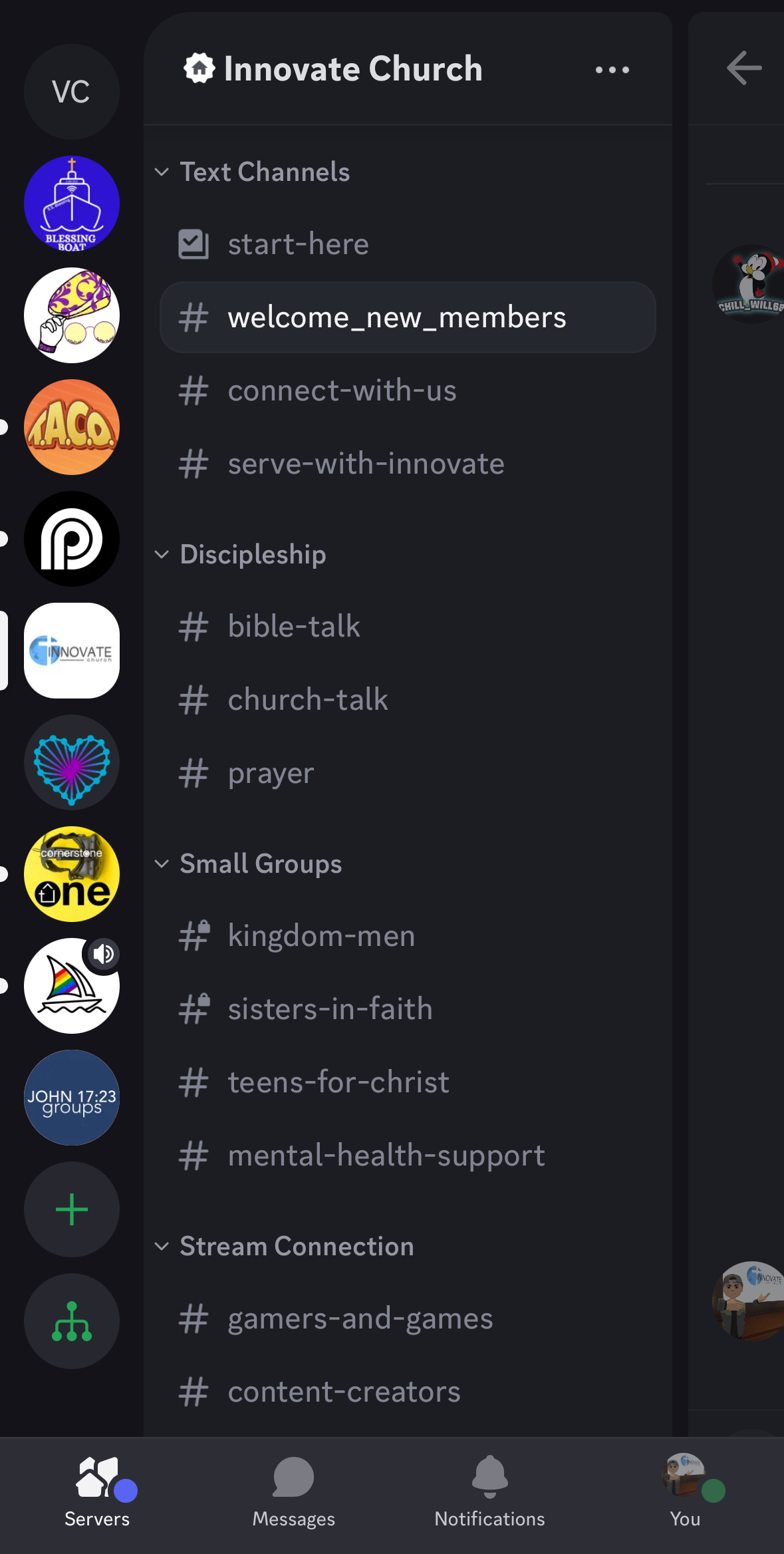
Once in the community, you’ll see a list of “Channels” on the left. Clicking on any of them takes you inside of that channel where you can post or join in the conversations already happening. Your post is only inside that specific channel. Hence, we have topic-based channels.
This is my app. You won’t have the bunch of icons on the left until you join multiple Discord communities as I have. You can see our channel list to the right of those icons…”Start-Here,” “Welcome-New-Members,” etc. If the channel has a little lock icon like the Kingdom Men channel does, that is because it is an invite-only channel. An admin, or myself, can invite you in.
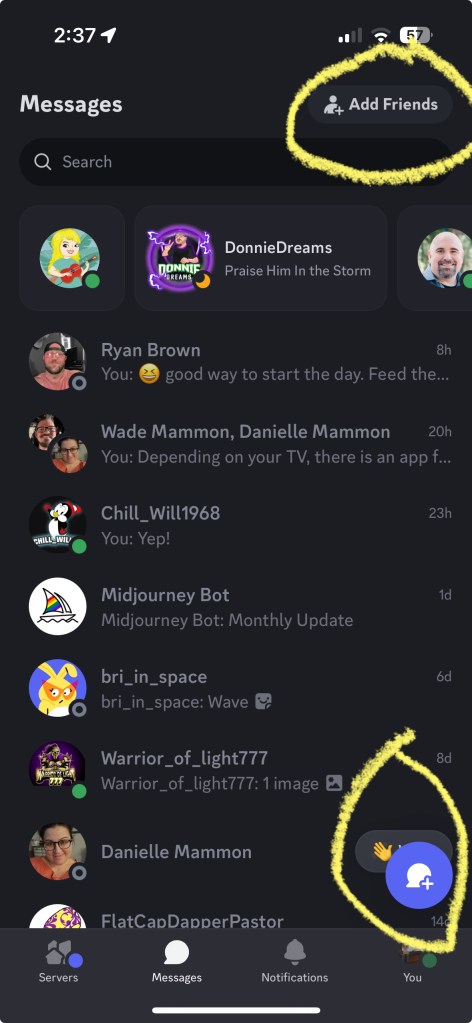
At the bottom of your screen, you see the 4 icons, or buttons.
The left one is to get back to the server page…so you can see the list of channels again, or the channel you are in.
The second button is for your messaging. This is where direct messages are kept.
There are two important buttons I circled here. The top one is your “Add Friends” button. There you can search for friends or message someone off Discord an invite link. The circled button at the bottom is used to begin a new message.
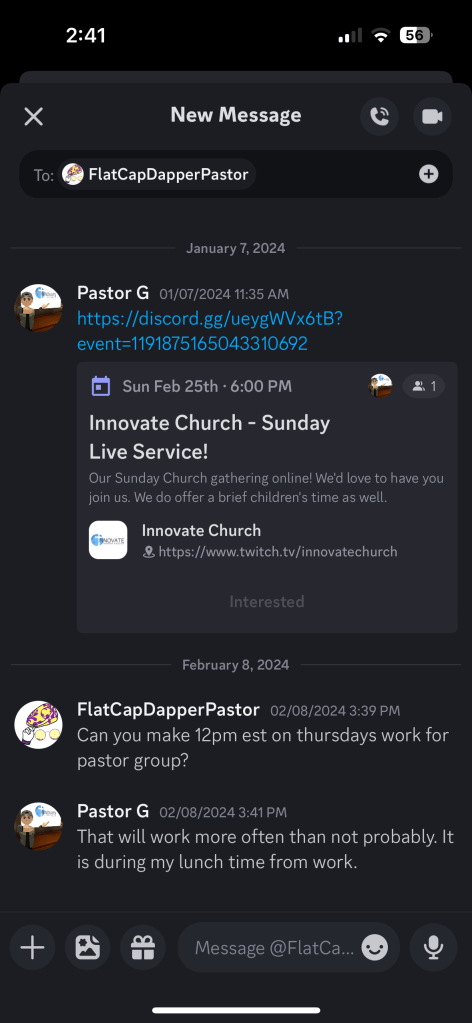
Once you’ve chosen the friend(s) you want to message it will bring you to the message composing screen. It’s similar to others you’ve seen.
At the top right, you see the option of calling or video chatting.
Just below that, you see who you are messaging. The little plus sign to the right of their name allows you to add others to the message…like a group text.
At the very bottom, the plus sign allows you to attach files or open the camera to take a photo.
The image button to the right of the plus sign is for attaching a photo you’ve already taken or animage stored on your phone.
The little “Gift” icon is to purchase “gift” someone an upgraded level of Discord…you won’t likely use this unless you’re feeling generous and want to pay someone’s Discord “Nitro” subscription for their server.
The smiley face is of course the emotes, GIFs, and stickers just like you would in your Android or Apple texting app.
The microphone allows you to leave a voice message instead of text.
The last button at the bottom right of your app screen is your profile. There you can add your bio, photo, online status if you desire.
Notifications
One of the most important things is the notifications for your phone or device.
On your particular device you should find notification settings in your phone’s settings.
However, there are notification settings in Discord as well.
On the Server page, at the top you’ll see the server’s name and … to the right of the name. You can click those dots and find the notification setting for the entire channel. That’s one thing.
The other thing is the individual channels. Say there is one in particular that you want to ignore or be notified about everything. You can access the individual channel notifications by long pressing on the title of the channel. This pops up a menu for you.
I believe that is all friends. Of course I am here to help you navigate as needed.
Looking ahead, we’re excited about hosting more small group events, like ladies’ and men’s Bible studies, easily managed around personal schedules thanks to Discord.
Let’s make the shift to Discord together, fostering a vibrant, supportive, and deeply connected online church family.
I’m not pushing you to switch platforms I’m just seeking lost sheep.
Hey everyone,
I felt compelled to share some thoughts for those of you pondering whether to switch platforms. Straight off the bat: NO. Just because I’ve started streaming on Twitch doesn’t mean you need to jump ship from YouTube if that’s where you’ve been engaging with us. I’m not abandoning YouTube. Our videos will always have a home there, unlike on Twitch, where content isn’t permanent. And we will continue our live streams there.
Twitch isn’t a one-size-fits-all platform. It’s predominantly gamer territory. Yes, there’s a variety of content, especially in the “Just Chatting” category, but it still leans heavily towards gaming. Twitch, like YouTube, hosts a wide range of content, barring explicit nudity. Both platforms are vast seas of podcasts, news, cooking shows, fitness advice, and more. This diversity is both a risk and a benefit of the digital age.
So, why Twitch for me?
Our YouTube streams haven’t been catching many “drop-in” viewers. Without a substantial following, it’s tough to attract spontaneous visitors since YouTube tends to promote streams mainly to existing subscribers and those with much larger followings.
Experimenting with Twitch was something I wanted to try. I have friends in the digital church community there and had already been engaging with some content before deciding to stream there myself. Twitch’s culture is built around live streaming and fostering community interaction. Conversations are more likely and expected; it’s a place where viewers are encouraged to chat and engage directly with streamers.
More than just experimentation, I sensed a profound loneliness among many Twitch users. What leads someone to watch streams for hours on end? What does their daily life look like? Why do they choose streaming over spending time with family and friends? They’re seeking connection, belonging, and perhaps an escape, in the security of their own home. And it’s these individuals Innovate aims to welcome into our community, offering the acceptance and belonging they’re searching for.
To me, YouTube excels as an entertainment medium, striving for community but not quite achieving the same closeness you find on Twitch. Twitch is all about live content and making connections, whether as a streamer or viewer. These connections can lead to our online commmunity for deeper connection with us.
Interestingly, stats reveal YouTube viewership is primarily mobile, suggesting a more active, less isolated audience. In contrast, Twitch users predominantly watch from home PCs, indicating a more introverted viewer.
This isn’t about shifting our audience from one platform to another. It’s about reaching and serving those we feel called to include in our community. I want you to stay where you are comfortable.
A huge thanks to our followers on Twitch and YouTube alike. Your support means the world to us, and we value each of you equally. We love you!
If you’re seeking that closer community with us, then I want to invite you into our Discord community.
You can catch our live streamed activities on the platform your prefer, YouTube, Twitch, or even Facebook.
You can catch me on Twitch playing games, doing bible study, or whatever else I’m into on my Pastor G channel.
Question: How does the story of God showing Abraham the stars relate to the concept of beauty connecting us to God’s promises?
Genesis 15:5 – “He took him outside and said, ‘Look up at the sky and count the stars—if indeed you can count them.’ Then he said to him, ‘So shall your offspring be.'”
Beauty in Creation:
Question: In what ways does the beauty of creation around us point to the glory and character of God?
Psalm 19:1 – “The heavens declare the glory of God; the skies proclaim the work of his hands.”
Longing for Beauty:
Question: How does our innate longing for beauty reflect our deeper longing for God and His kingdom?
Psalm 27:4 – “One thing I ask from the Lord, this only do I seek: that I may dwell in the house of the Lord all the days of my life, to gaze on the beauty of the Lord and to seek him in his temple.”
Beauty’s Role in Faith:
Question: How can beauty, as seen in nature or art, aid in strengthening or awakening faith in God?
Scripture: [Open for discussion; consider exploring how nature and art often lead to moments of spiritual reflection and awakening.]
Beauty and Worship:
Question: Discuss how acts of beauty, like the woman anointing Jesus with perfume, can be forms of worship and devotion.
Matthew 26:6-13 – The account of the woman anointing Jesus with expensive perfume, demonstrating an act of beauty and worship.
Eternal Beauty:
Question: What does it mean for Christians to be ‘adorned in beauty’ in eternity, as mentioned in Revelation 21?
Revelation 21:2 – “I saw the Holy City, the new Jerusalem, coming down out of heaven from God, prepared as a bride beautifully dressed for her husband.”








 Gerald Faulkner