The Journey of Spiritual Hunger and Thirst

This post has been generated with the help of AI, reflecting on the themes and teachings from my recent sermon.

Today I’d like to share some insights from a recent sermon I shared with Innovate Church on April 28, 2024. Let’s explore together the deep questions about our spiritual journey and the answers that can guide us toward a life of righteousness.

What does it mean to truly hunger and thirst for righteousness?

To “hunger and thirst for righteousness” means feeling a profound, persistent desire to align one’s life with God’s will. Imagine the deepest physical hunger or thirst you’ve experienced; this is how our spirit feels about righteousness. Matthew 5:6 from the Beatitudes promises us that such spiritual longings will be satisfied. This beatitude emphasizes the necessity of recognizing our spiritual emptiness and the need to fill it with divine presence and guidance.

How do the previous Beatitudes prepare us for this hunger and thirst?

The earlier Beatitudes set the stage for a true craving for righteousness. Being “poor in spirit” means acknowledging our complete dependence on God, devoid of spiritual pride. Mourning our sins leads to a repentant heart, while meekness cultivates humility—essential steps before we can earnestly seek righteousness. These spiritual conditions prime our hearts to receive and cherish the divine righteousness that God alone can provide.

What are practical steps to cultivate a life that hungers and thirsts for righteousness?

Cultivating such a life involves deliberate spiritual disciplines. Just as one might clean unhealthy foods out of their fridge to improve physical health, we must also clear our lives of spiritual impediments. Replacing them with regular prayer, meditation, Scripture study, and engaging in community with fellow believers are essential practices. These habits help us fill the void left by worldly desires with something infinitely more nourishing.

How do we maintain our spiritual health and hunger in times of temptation and challenge?

Maintaining spiritual health, especially during challenges, requires resilience and continuous spiritual nourishment. Analogous to dieting, where one might switch to healthier food options, our spiritual life also demands regular attention and adjustment. Temptations are like the unhealthy snacks that tempt us; we must consciously choose to reject them and replace them with wholesome spiritual practices.

How can we support each other in our quest for righteousness?

Communal support is crucial in our spiritual journey. Like athletes who benefit from the encouragement of coaches and fans, we thrive spiritually within a supportive community. In our church, we foster an environment where members can share their struggles and victories, providing encouragement and accountability. This communal support is vital for nurturing our spiritual growth and perseverance.

What is the ultimate promise for those who pursue this path?

The ultimate promise for those diligently seeking righteousness is profound peace and fulfillment—far surpassing temporary earthly pleasures. “Blessed are those who hunger and thirst for righteousness, for they shall be satisfied.” This divine assurance promises enduring fulfillment and a closer alignment with God’s purpose for our lives.

Thank you for joining me in reflecting on these spiritual truths. As we continue to seek God’s righteousness, let us support one another and share the joy of a life that is truly satisfied in Christ.

Find Support in Your Spiritual Journey

Don’t walk the Spiritual journey alone. Walk it with us. Let us encourage and spur you on to good works. We have a Discord community where we connect and encourage each other throughout the week we’d love you to join. There you can also keep up with our live church online activities like our Thursday night Zoom Bible studies and Sunday livestream church services. Won’t you join us?

Finding Hope in Suffering: You Are Not Alone

Blog post adapted from my sermon transcript on Jesus’s “I Am the Resurrection and the Life” statement using AI.

Have you ever felt completely alone in your pain and suffering? Like no one understands what you’re going through? The loneliness and isolation can feel suffocating at times.

I want you to know that you are not alone. There is a community of people who have been where you are. And more importantly, there is a Savior named Jesus who intimately understands your suffering. He promises never to leave or forsake you.

The Weight of Loneliness
In the Gospel of John, we read about two sisters named Mary and Martha who were dealing with overwhelming grief after the death of their brother Lazarus. They sent word to Jesus that the one he loved was ill, surely hoping he would come quickly. But Jesus delayed. By the time he arrived, Lazarus had been dead four days.

Mary and Martha must have felt so alone in their mourning. Where was Jesus, whom they thought of as a friend? Why did he take so long to come? The sting of death was bad enough without feeling abandoned too.

Maybe you can relate to those feelings of isolation and abandonment that Mary and Martha experienced. A loved one gone. Prayers that seem to go unanswered. An all-consuming sadness. You cry out, “God, why have you left me alone in this pit of darkness?”

The Truth of His Presence
But here’s the truth – you are not alone. Not ever. Jesus made an astounding claim to Martha that day at the tomb of Lazarus. He said, “I am the resurrection and the life. Whoever believes in me, though he die, yet shall he live.”

Jesus was letting Martha know that He has power over death itself. Death is not the end. And He is intimately present with us, even in our darkest valleys. He does not just observe our suffering from a distance. He weeps with us (John 11:35). He understands our anguish in a profound way.

In fact, Jesus experienced the ultimate loneliness and isolation when he took on the sins of the world. On the cross, he was forsaken by the Father so that we would never have to be separated from God’s love. Jesus became sin itself so that we could be made right with God (2 Corinthians 5:21). He drank the cup of God’s wrath over sin so that we could drink the cup of acceptance as children of God.

Purpose in the Pain
Not only does Jesus intimately experience our suffering with us, He has an eternal purpose for allowing it. The Bible tells us that our present sufferings “are not worth comparing with the glory that is going to be revealed to us” (Romans 8:18). Our momentary afflictions are “preparing for us an eternal weight of glory beyond all comparison” (2 Corinthians 4:17).

Jesus demonstrated this when he intentionally delayed going to Lazarus so that God’s power could be displayed in raising him from the dead. Your pain may seem purposeless now. But Jesus promises that He will use it to accomplish something of eternal significance, if you trust Him. Your suffering is never wasted in His hands.

An Invitation to Belong
Not only do you never have to feel alone in your trials, you are invited into a loving community of people who will weep with you, pray with you, and carry your burdens. Church is not just a building or an organization – it is a spiritual family.

As the sermon said, “You are not to be a Christian out there living the faith alone. You’re part of the body. You need to be reattached with the body…We will take you in if you’re a lone Christian out there looking for family, or even if you’re not even Christian yet, you’re just kind of interested or curious. We’ll welcome you.”

You belong. You are wanted. You are loved, despite your failures and shortcomings. The arms of this spiritual family are open wide to embrace you.

An Eternal Hope
Jesus does not abandon his people to the grave. When he resurrected Lazarus, it foreshadowed His own bodily resurrection three days after his death on a cross. By conquering death, Jesus has secured eternal life for all who put their faith in Him.

“As he declared, “Whoever lives and believes in me shall never die” (John 11:26). Physical death is merely a temporary sleep. For those who put their faith in Jesus as the resurrection and the life, physical death is just a passing from this life into eternal life with Him.

Jesus said, “I am the resurrection and the life. The one who believes in me will live, even though they die” (John 11:25). Our earthly bodies may die, but we will be resurrected into new, imperishable bodies to live forever with Christ. Death is swallowed up in victory (1 Corinthians 15:54)!

So you see, even when walking through the darkest valley of suffering and death, we never have to fear. We can take comfort that Jesus has triumphed over sin, death, loneliness and pain. By His resurrection, He has secured for us eternal life and the promise to wipe away every tear from our eyes (Revelation 21:4). Our suffering now is temporary; eternal joy awaits for those who put their hope in the risen Savior.”

Your Personal Invitiation

Join us in our Discord community.

Embracing Discord: Our Church’s Community Hub

I previously touched on not pushing a move from YouTube to Twitch. Now, I’m spinning the narrative a bit because I’m all in on getting us onto Discord. Here’s the scoop on why and how.

Being a digital-only church means we lack a physical space. No building, no signs, no traditional gathering spots. But here’s the thing: our church is never “closed.” We’re up and running 24/7, every day of the year, offering community for those who might not sync up with our live streaming times. This is the beauty of what’s known as an “asynchronous community.”

Discord, like online forums and Facebook Groups, thrives on this concept. It’s not about when you post, but what you post, centered around shared goals or topics. This model is a game-changer for online churches, allowing us to foster fellowship and spiritual growth in new ways.

Why Discord Shines for Us:

  • Flexibility and Inclusion: One of the standout benefits is the flexibility in participation. Whether it’s due to varying schedules, different time zones, or personal preferences, asynchronous communities allow church members to engage in their own time. This inclusivity ensures that everyone, from the homebound to the international member, can be an active part of our church family.
  • Richer Conversations: Unlike the fleeting moments of our in-person gatherings, asynchronous platforms enable deeper, more reflective discussions. Members can ponder over sermon discussions, share prayer requests, or contribute to Bible study with thoughtful responses. This not only enriches the quality of interactions but also fosters a deeper spiritual connection among members.
  • Continuous Spiritual Journey: With a record of conversations and shared resources easily accessible, the spiritual journey doesn’t pause between services. Instead, it continues to flourish, with members revisiting sermons, discussions, and following up on prayer requests at their leisure. This ongoing engagement strengthens faith and community bonds.
  • Cost-Effective Community: For churches operating on limited resources, asynchronous platforms present a cost-effective way to maintain a vibrant church community. From private groups for sensitive support discussions to open forums for general fellowship, these platforms accommodate the full spectrum of church life.

I see our Discord server as a digital church building, where each channel is a room for different small groups or discussions. It’s a place where connections made can be deeper than those in traditional settings.

My dream? A place where anyone can share, day or night, and feel seen and supported by a community that cares deeply.

We already have channels in the community for gender-specific groups, mental health support, bible and church talk, and others that offer spaces for conversation and connection on a range of themes. And it costs us nothing to add a new channel, a new small group ministry, or a resource in this space. There are no rooms to build and often no need for a volunteer leader. Adding a new channel or group is easy and free, making our community space infinitely expandable.

What About Facebook and Texting?

Facebook has its place, but while we have a group there, it isn’t particularly helpful or well-engaged. Part of the problem is how Facebook chooses what it shares with everyone even if you’re a member of the group. I may post something, and you never know it because Facebook didn’t notify you. I also find Facebook’s group features a bit confusing in many ways. Then there are all the Facebook distractions that I hate. Today most of us are on Facebook because it’s been ingrained into us that “we’re supposed” to be on Facebook.

With Discord, there are no distractions. It is nothing but conversation that is easy to follow in most cases. The sharing of ideas and encouragement. You can easily get notifications on your mobile device informing you of new posts, direct messages, or even event reminders.

Texting has been our primary “during the week” communication outside of our online times together. Texting is great for instant communication. But, again, when it comes to having a “permanent” record of communication and conversation others might learn from, an asynchronous group is much better. For bible studies online or trying to lead a small group and share videos or readings with one another, that’s all a bit more difficult.

Another concern I have about maintaining a texting group is the safety aspect. We’re giving out our actual phone numbers to others in the belief these folks are going to be “good” and indeed most are. But what about when one does come in, or maybe one goes off the rails a bit? It’s also not super convenient to add new folks due to creating a new group and making sure everyone announces who they are so everyone knows whose number is who’s. Right now, it has worked for us, but as we continue to add folks, it’s going to become more difficult and possibly more unsafe in the future.

Discord has a direct messaging feature which may be a way for us to connect. You can have multiple groups, and no one shares their phone number. You can even do voice call channels or groups and use it like Zoom if desired. Just like a text message, you’d get a notification on your phone alerting you to either a DM or a new post in the Discord group.

So, while Twitch wasn’t the move, Discord definitely is. It’s the best spot for our church’s online interactions, offering a free, flexible, and safe environment for our community to thrive.

And, just to keep you up to date, we are looking to do more small group events such as a ladies’ Bible study hosted by one of our members, and a men’s bible study hosted by one of our members or myself. This is another great benefit of Discord because we can have folks easily run groups around their own schedules. Everyone doesn’t have to be online at a certain time unless there’s a live teaching. So each person can watch, read, listen to, whatever the group is studying and then comment, discuss, when they have time.

How Do You Use Discord?

I know that’s a question for some of you, so I wanted to include a few screenshots to help with this. These are all from an iPhone but the principles are nearly identical for Android and apply to a large degree if you use the web browser or PC program.

First, you’ll need to download the app from your brand’s app store.

You’ll need to open it and register a new account. Like anything, it’ll ask you for your email, user name, create a password, etc. It will likely ask for permission to use your phone, mic, camera, etc…all of which allow you to share things from your phone to Discord when you want to share a picture, make a call, etc.

Once everything is setup you’re ready to join our server. Sadly, the only way to do this is by using an invite link. If you go to the Innovate Church website, the “Join Our Community” button is an actual invite link. If you press it on your phone, it should open the Discord app for you. And it should take you to our “Start Here” channel. (Here’s the invite link as well so you can do it straight from this blog if you desire).

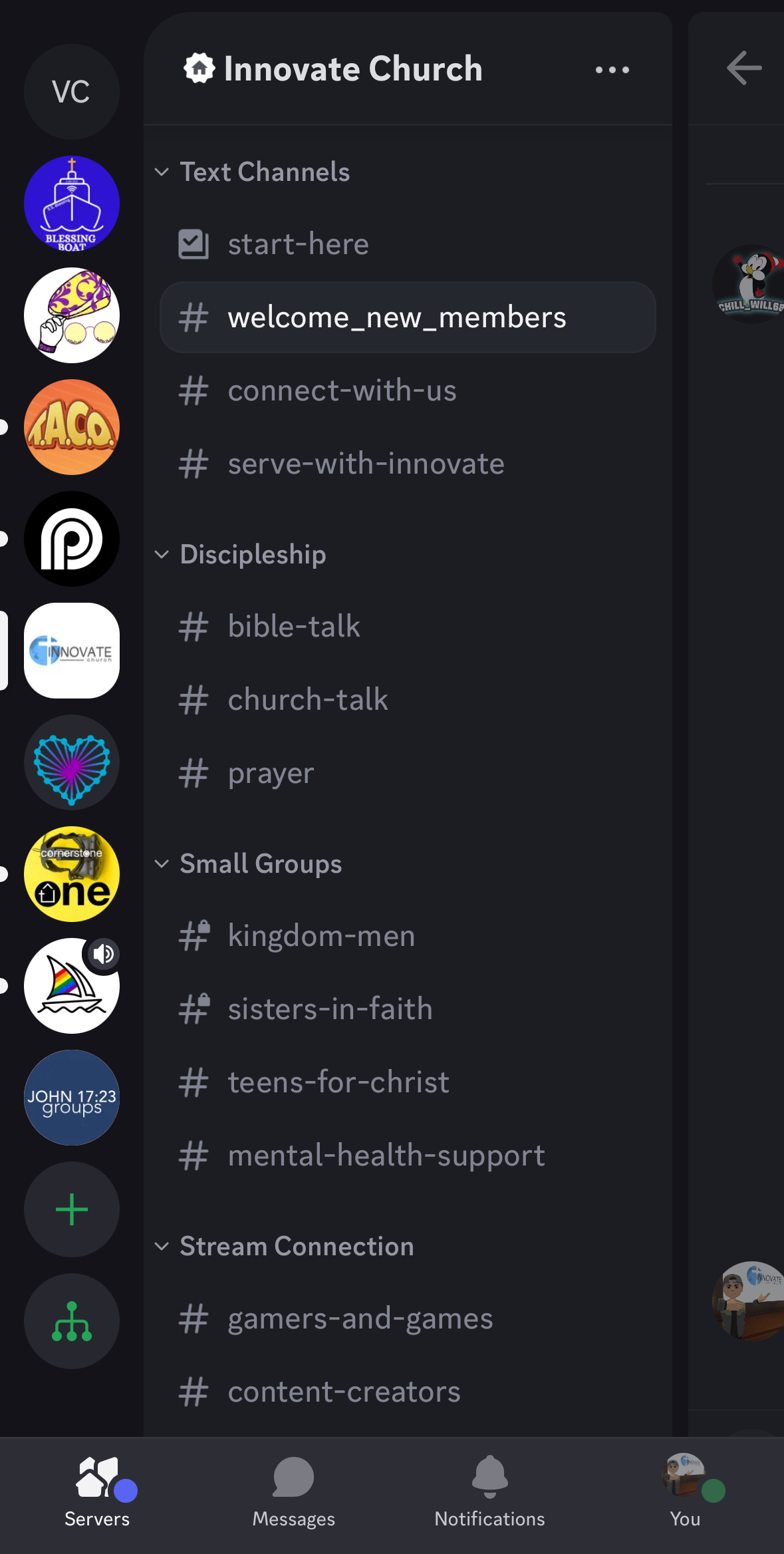
Once in the community, you’ll see a list of “Channels” on the left. Clicking on any of them takes you inside of that channel where you can post or join in the conversations already happening. Your post is only inside that specific channel. Hence, we have topic-based channels.

This is my app. You won’t have the bunch of icons on the left until you join multiple Discord communities as I have. You can see our channel list to the right of those icons…”Start-Here,” “Welcome-New-Members,” etc. If the channel has a little lock icon like the Kingdom Men channel does, that is because it is an invite-only channel. An admin, or myself, can invite you in.

At the bottom of your screen, you see the 4 icons, or buttons.

The left one is to get back to the server page…so you can see the list of channels again, or the channel you are in.

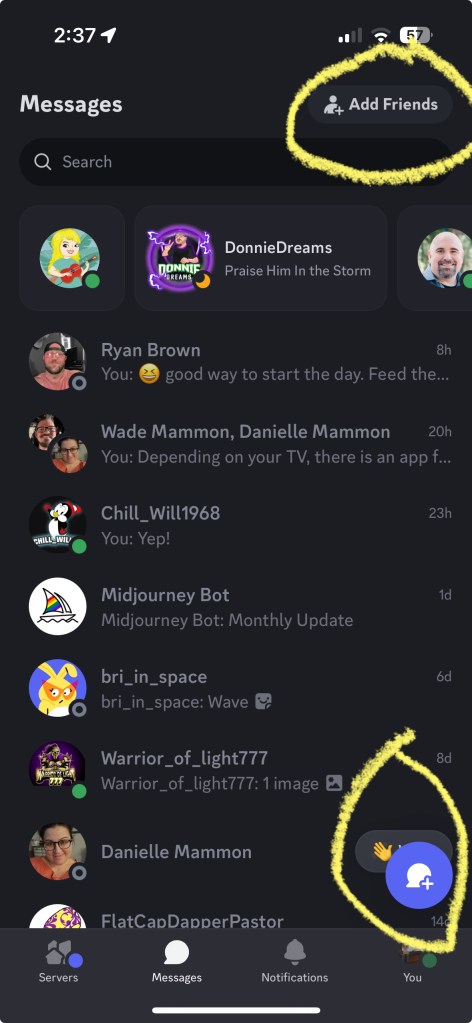
The second button is for your messaging. This is where direct messages are kept.

There are two important buttons I circled here. The top one is your “Add Friends” button. There you can search for friends or message someone off Discord an invite link. The circled button at the bottom is used to begin a new message.

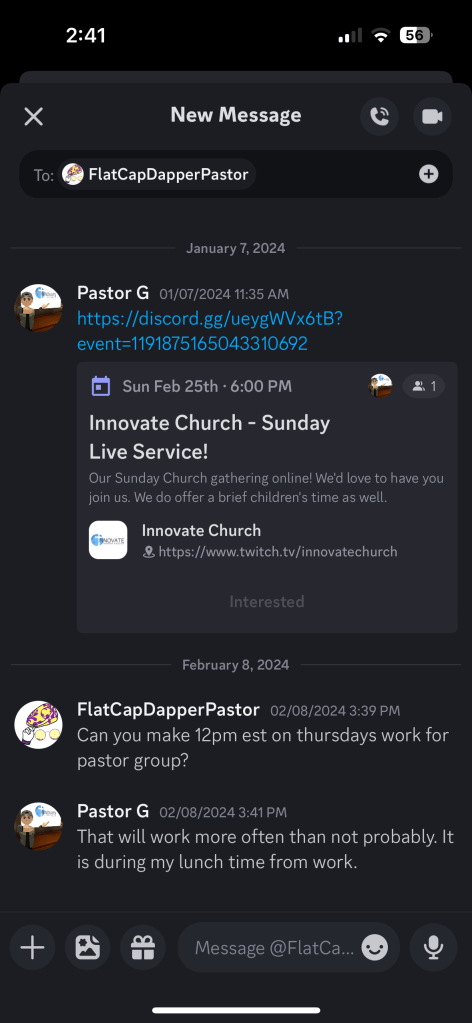
Once you’ve chosen the friend(s) you want to message it will bring you to the message composing screen. It’s similar to others you’ve seen.

  • At the top right, you see the option of calling or video chatting.
  • Just below that, you see who you are messaging. The little plus sign to the right of their name allows you to add others to the message…like a group text.
  • At the very bottom, the plus sign allows you to attach files or open the camera to take a photo.
  • The image button to the right of the plus sign is for attaching a photo you’ve already taken or an image stored on your phone.
  • The little “Gift” icon is to purchase “gift” someone an upgraded level of Discord…you won’t likely use this unless you’re feeling generous and want to pay someone’s Discord “Nitro” subscription for their server.
  • The smiley face is of course the emotes, GIFs, and stickers just like you would in your Android or Apple texting app.
  • The microphone allows you to leave a voice message instead of text.

The last button at the bottom right of your app screen is your profile. There you can add your bio, photo, online status if you desire.

Notifications

One of the most important things is the notifications for your phone or device.

On your particular device you should find notification settings in your phone’s settings.

However, there are notification settings in Discord as well.

On the Server page, at the top you’ll see the server’s name and … to the right of the name. You can click those dots and find the notification setting for the entire channel. That’s one thing.

The other thing is the individual channels. Say there is one in particular that you want to ignore or be notified about everything. You can access the individual channel notifications by long pressing on the title of the channel. This pops up a menu for you.

I believe that is all friends. Of course I am here to help you navigate as needed.

Looking ahead, we’re excited about hosting more small group events, like ladies’ and men’s Bible studies, easily managed around personal schedules thanks to Discord.

Let’s make the shift to Discord together, fostering a vibrant, supportive, and deeply connected online church family.

YouTube or Twitch – Where Do YOU Fit?

I’m not pushing you to switch platforms I’m just seeking lost sheep.

Hey everyone,

I felt compelled to share some thoughts for those of you pondering whether to switch platforms. Straight off the bat: NO. Just because I’ve started streaming on Twitch doesn’t mean you need to jump ship from YouTube if that’s where you’ve been engaging with us. I’m not abandoning YouTube. Our videos will always have a home there, unlike on Twitch, where content isn’t permanent. And we will continue our live streams there.

Twitch isn’t a one-size-fits-all platform. It’s predominantly gamer territory. Yes, there’s a variety of content, especially in the “Just Chatting” category, but it still leans heavily towards gaming. Twitch, like YouTube, hosts a wide range of content, barring explicit nudity. Both platforms are vast seas of podcasts, news, cooking shows, fitness advice, and more. This diversity is both a risk and a benefit of the digital age.

So, why Twitch for me?

Our YouTube streams haven’t been catching many “drop-in” viewers. Without a substantial following, it’s tough to attract spontaneous visitors since YouTube tends to promote streams mainly to existing subscribers and those with much larger followings.

Experimenting with Twitch was something I wanted to try. I have friends in the digital church community there and had already been engaging with some content before deciding to stream there myself. Twitch’s culture is built around live streaming and fostering community interaction. Conversations are more likely and expected; it’s a place where viewers are encouraged to chat and engage directly with streamers.

More than just experimentation, I sensed a profound loneliness among many Twitch users. What leads someone to watch streams for hours on end? What does their daily life look like? Why do they choose streaming over spending time with family and friends? They’re seeking connection, belonging, and perhaps an escape, in the security of their own home. And it’s these individuals Innovate aims to welcome into our community, offering the acceptance and belonging they’re searching for.

To me, YouTube excels as an entertainment medium, striving for community but not quite achieving the same closeness you find on Twitch. Twitch is all about live content and making connections, whether as a streamer or viewer. These connections can lead to our online commmunity for deeper connection with us.

Interestingly, stats reveal YouTube viewership is primarily mobile, suggesting a more active, less isolated audience. In contrast, Twitch users predominantly watch from home PCs, indicating a more introverted viewer.

This isn’t about shifting our audience from one platform to another. It’s about reaching and serving those we feel called to include in our community. I want you to stay where you are comfortable.

A huge thanks to our followers on Twitch and YouTube alike. Your support means the world to us, and we value each of you equally. We love you!

If you’re seeking that closer community with us, then I want to invite you into our Discord community.

You can catch our live streamed activities on the platform your prefer, YouTube, Twitch, or even Facebook.

You can catch me on Twitch playing games, doing bible study, or whatever else I’m into on my Pastor G channel.

Rembrandt in the Wind – Study Session 1

Adapted from the study, and book, by Russ Ramsey. Audible book available.

YouTube: Watch Session 1.

“Have you ever tried to create art, like drawing, painting, or sculpting? What was that experience like for you?”

Discussion Questions

Art and Self-Expression

How does art, like the self-portraits of Vincent van Gogh, help us understand and express our own emotions and experiences?

Psalm 139:14 – “I praise you because I am fearfully and wonderfully made; your works are wonderful, I know that full well.” (Reflects on the beauty and intricacy of God’s creation, including humanity.) What if we are His self-reflection?

Brokenness and Beauty

In what ways can our personal brokenness lead to beauty, especially when viewed through the lens of compassion and healing? 

2 Corinthians 4:7 – “But we have this treasure in jars of clay to show that this all-surpassing power is from God and not from us.” (Speaks to the beauty and value in our brokenness and imperfection.)

Truth in Art

Why is it important to depict truth in art, and how can this be compared to living a life of truth as a Christian?

Ephesians 2:10 – “For we are God’s handiwork, created in Christ Jesus to do good works, which God prepared in advance for us to do.” (Emphasizes our creation in God’s image and our purpose in His plan.)

Goodness, Truth, and Beauty: 

Philippians 4:8 – “Finally, brothers and sisters, whatever is true, whatever is noble, whatever is right, whatever is pure, whatever is lovely, whatever is admirable—if anything is excellent or praiseworthy—think about such things.” (Encourages the pursuit of goodness, truth, and beauty.)

How do goodness, truth, and beauty reflect the nature of God, and how can we pursue these in our daily lives?

Creativity and God’s Image

What does it mean to be made in the image of God, especially in terms of creativity and our call to create?

Genesis 1:26-27 – “Then God said, ‘Let us make mankind in our image, in our likeness…’ So God created mankind in his own image, in the image of God he created them; male and female he created them.” (Highlights the creative aspect of being made in God’s image.)

Community and Creativity

How does community enhance our ability to create and appreciate beauty? 

Hebrews 10:24-25 – “And let us consider how we may spur one another on toward love and good deeds, not giving up meeting together…but encouraging one another…” (Illustrates the importance of community in fostering growth and creativity.)

Honesty in Self-Reflection: 

James 1:23-24 – “Anyone who listens to the word but does not do what it says is like someone who looks at his face in a mirror and, after looking at himself, goes away and immediately forgets what he looks like.” (A metaphor for self-reflection and honesty in our spiritual walk.)

How can being honest in our self-reflection, much like an artist creating a self-portrait, help us grow spiritually?

Value and Worth: 

1 Peter 2:9 – “But you are a chosen people, a royal priesthood, a holy nation, God’s special possession, that you may declare the praises of him who called you out of darkness into his wonderful light.” (Reminds us of our value and purpose in God’s eyes, despite our imperfections.)

How does understanding our value in God’s eyes, despite our flaws and brokenness, change the way we interact with others?

Scripture References

Psalm 139:14 – “I praise you because I am fearfully and wonderfully made; your works are wonderful, I know that full well.”

2 Corinthians 4:7 – “But we have this treasure in jars of clay to show that this all-surpassing power is from God and not from us.”

Ephesians 2:10 – “For we are God’s handiwork, created in Christ Jesus to do good works, which God prepared in advance for us to do.”

Philippians 4:8 – “Finally, brothers and sisters, whatever is true, whatever is noble, whatever is right, whatever is pure, whatever is lovely, whatever is admirable—if anything is excellent or praiseworthy—think about such things.”

Genesis 1:26-27 – “Then God said, ‘Let us make mankind in our image, in our likeness…’ So God created mankind in his own image, in the image of God he created them; male and female he created them.”

Hebrews 10:24-25 – “And let us consider how we may spur one another on toward love and good deeds, not giving up meeting together…but encouraging one another…”

James 1:23-24 – “Anyone who listens to the word but does not do what it says is like someone who looks at his face in a mirror and, after looking at himself, goes away and immediately forgets what he looks like.”

1 Peter 2:9 – “But you are a chosen people, a royal priesthood, a holy nation, God’s special possession, that you may declare the praises of him who called you out of darkness into his wonderful light.”

My Personal Notes from the Video

  • We hide what needs redemption
  • Concerned with goodness and truth
  • Created to be creative
  • God gave Adam and Eve as others and gave them others  -community
  • We are drawing the self-portrait pretending I am ok.
  • Broken but unimaginably valued by God

Getting Healthy, Wealthy, and Wise in 2024

A blog adapted, using AI, based on my recent teaching which you can find on YouTube.

What We Can Learn from the Bible About Fitness and Health Goals

It’s a new year, which means New Year’s resolutions are in full swing. As we all know, most resolutions fail pretty quickly. By the end of January, almost half have already been abandoned. But as Christians, maybe we can do better if we approach our goals from a biblical perspective.

In his letters, the apostle Paul uses the analogy of runners competing in a race. He points out that while every runner runs, only one takes home the prize (1 Cor 9:24). This tells us a couple things about achieving our goals:

1) We need determination and endurance to reach the finish line. Quitting early means we automatically fail.

2) We should run with purpose and strategy, not “aimlessly” (1 Cor 9:26). Vague resolutions without concrete plans won’t get us far.

When it comes to health and fitness goals specifically, having S.M.A.R.T. goals can make a big difference – goals that are Specific, Measurable, Achievable, Relevant, and Time-bound. Getting more granular helps us track progress incrementally instead of getting discouraged by slow results. For example, aiming to lose 30 pounds this year breaks down to around 2-3 pounds per month. Much more motivating!

Of course, pursuing any goal requires self-control and discipline, two concepts most of us try to avoid (1 Cor 9:27). But ultimately, mastering our bodies and choices demonstrates good stewardship of the physical blessings God has already given us. After all, our bodies are temples where the Holy Spirit resides, purchased by Christ at a great price (1 Cor 6:19-20). Caring for them honors God.

The temptation and lust to overindulge have threatened mankind since the earliest biblical days. Gluttony may not get mentioned much from church pulpits, but Proverbs clearly warns against becoming “drunkards or…gluttonous eaters” (Prov 23:20-21). Excess food and drink dull our discipline, hurt our health, and distract us from Godly pursuits. As the Scottish Olympian Eric Liddell showed in Chariots of Fire, obeying our convictions sometimes means saying no to fleshly appetites.

Above all, Paul stresses keeping first things first. Physical training offers some benefits, but “godliness is of value in every way” for this life and the next (1 Tim 4:7-8). Health goals shouldn’t overtake our relationship with God. In a few weeks, we’ll look more closely at priorities for spiritual growth in 2024.

What physical goals do you hope to achieve this year? What practical steps can you take to give them the best shot at success? As you ponder, ask God to increase your self-control, consistency, and trust in His provision. Our bodies and our dreams matter to Him. Let’s care for both in a way that brings glory to His name.

Thankful for the Call to Share God’s Gifts

Sermon notes for this sermon here.

Introduction:

Recap the journey of the past three weeks: grace, mercy, and sovereignty.

Introduce the theme: “Thankful for the Call to Share God’s Gifts.

Explain how we are not just recipients but also conduits of God’s grace, mercy, and sovereignty.

Enjoy, Apply, and Share

Proverbs 23:12 (ESV)

   Apply your heart to instruction and your ear to words of knowledge.

I. The Gift of Sharing

What are we to do with the gifts we have received?

The Best Seed

There once was a farmer who grew the most excellent wheat. Every season he won the award for the best wheat in his county.

A wise woman came to him to ask him about his success.

He told her that the key was sharing his best seed with his neighbors so they could plant the seed as well.

The wise woman asked, “How can you share your best wheat seed with your neighbors when they compete with you every year?”

“That’s simple,” the farmer replied.

“The wind spreads the pollen from everyone’s wheat and carries it from field to field. If my neighbors grew inferior wheat, cross-pollination would degrade everyone’s wheat, including mine. If I’m to grow the best wheat, I must help my neighbors grow the best wheat as well.”

1 Peter 4:10 (ESV)

As each has received a gift, use it to serve one another, as good stewards of God’s varied grace:

The farmer in our story was a good steward of what the Lord had given him, including wisdom.

Has God not given you His best gifts? That of, His Grace, His Mercy, and His sovereign care for us?

And if He has, then shouldn’t we, out of our gratitude give to others as He has given to us?

Imagine the change in your family, in your community, in the world, if we Christians gave as God has given us!

II. Sharing God’s Grace

Ephesians 4:32 (ESV)

Be kind to one another, tenderhearted, forgiving one another, as God in Christ forgave you.

When a person works an eight-hour day and receives a fair day’s pay for his time, that is a wage. When a person competes with an opponent and receives a trophy for his performance, that is a prize. When a person receives appropriate recognition for his long service or high achievements, that is an award. But when a person is not capable of earning a wage, can win no prize, and deserves no award–yet receives such a gift anyway–that is a good picture of God’s unmerited favor. This is what we mean when we talk about the grace of God.

G.W. Knight, Clip-Art Features for Church Newsletters,  p. 53.

Grace received should result in grace being given.

We forgive because we have been forgiven.

God’s unmerited favor, is His kindness towards us. We don’t deserve it, but He chose to give it to us.

Instead of waiting for someone to “deserve” grace, or forgiveness, we are called to be the first to do so.

III. Sharing God’s Mercy

Luke 6:36 (ESV)

Be merciful, even as your Father is merciful.

What is mercy you ask?

A mother once approached Napoleon seeking a pardon for her son. The emperor replied that the young man had committed a certain offense twice and justice demanded death. 

“But I don’t ask for justice,” the mother explained. “I plead for mercy.” 

“But your son does not deserve mercy,” Napoleon replied. 

“Sir,” the woman cried, “it would not be mercy if he deserved it, and mercy is all I ask for.” 

“Well, then,” the emperor said, “I will have mercy.” And he spared the woman’s son. 

Luis Palau, Experiencing God’s Forgiveness, Multnomah Press, 1984.

Our God is indeed a God of justice, but we need to be ever so thankful that He is a God of mercy.

If He were not merciful, if He didn’t show you mercy, what is it you deserve? Death. Hell. Eternal separation from the Father.

Ephesians 2:4–5 (ESV)

But God, being rich in mercy, because of the great love with which he loved us, 5 even when we were dead in our trespasses, made us alive together with Christ—by grace you have been saved—

Let us remember in our own personal dealings with those who may deserve the consequences of their actions, that we also deserve consequences that God in His great mercy has chosen not to give us.

If He has shown us great mercy then we too should be people quick to show mercy to others.

IV. Sharing God’s Sovereignty

Isaiah 46:9-10

“Remember the former things of old; for I am God, and there is no other; I am God, and there is none like me, declaring the end from the beginning and from ancient times things not yet done, saying, ‘My counsel shall stand, and I will accomplish all my purpose.‘”

Sharing about God’s sovereignty in our lives can inspire others to trust Him.

When we can speak of and share the stories of our own trials and tribulations, and share that same word that Joseph shared with his brothers when they thought they were going to finally get what they deserved:

Genesis 50:20 (ESV)

As for you, you meant evil against me, but God meant it for good, to bring it about that many people should be kept alive, as they are today.

I want to point out though, verse 19

Genesis 50:19 (ESV)

But Joseph said to them, “Do not fear, for am I in the place of God? 

Joseph now saw God’s sovereignty at work, even through his own brothers’ actions. Because of that, he realized he had no right to be upset with how his brothers had done him because from God caused good to occur.

He wasn’t angry with his brothers, or even with God.

How about you? In sharing your own story you can help others to see hope in their own situation. Hope that God will bring about good from their pain because of His sovereign care for them.

Reminding them of Jeremiah’s words:

Jeremiah 29:11 (ESV)

For I know the plans I have for you, declares the LORD, plans for welfare and not for evil, to give you a future and a hope.

As redeemed people of Christ, we should be a people of hope in the world, 

1 Peter 3:15 (ESV)

always prepared to make a defense to anyone who asks you for a reason for the hope that is in you…

Trusting in His sovereignty helps us to know that no matter what happens in life, or how we may feel we have failed Him, He will achieve His purposes through us and lead us into life eternal with Him.

Even if you feel as though you have failed Him because of how you’ve not acted as you feel you should due to your circumstances, or maybe you’ve struck out on your own trying to do things your own way instead of trusting His plan for your life.

You’re not alone in that, we all have done so! 

So if you’re wrestling with this then I want to share about the next Gift He gives us:

V. The Gift of Salvation

During the building of the Golden Gate Bridge over San Francisco Bay, construction fell badly behind schedule because several workers had accidentally fallen from the scaffolding to their deaths. Engineers and administrators could find no solution to the costly delays. Finally, someone suggested a gigantic net be hung under the bridge to catch any who fell. Finally in spite of the enormous cost, the engineers opted for the net. After it was installed, progress was hardly interrupted. A worker or two fell into the net but were saved. Ultimately, all the time lost to fear was regained by replacing fear with faith in the net.

We are saved by grace, God’s unmerited favor given to us through our faith in Jesus Christ.

Jesus is our safety net. You may feel you have failed…

But God in his great mercy and grace, through His sovereignty, knew you would and gave you a safety net to fall into.

If we are thankful for this great gift then He has given us a Commission, a responsibility that shouldn’t feel like a chore as much as it should be a joy, an overflow of our own joy.

We get to tell others about this safety Net!

Matthew 28:19–20 (ESV)

Go therefore and make disciples of all nations, baptizing them in the name of the Father and of the Son and of the Holy Spirit, 20 teaching them to observe all that I have commanded you. And behold, I am with you always, to the end of the age.”

When we understand the value, the cost, and the importance of the gift, we want to tell others about it. 

This is our call, our mission, and our purpose.

All the gifts, all those trials and tribulations God has sovereignly allowed you to experience are to be used as tools in your efforts make disciples of others.

VI. Responding to the Call

2 Corinthians 5:18–20 (ESV)

All this is from God, who through Christ reconciled us to himself and gave us the ministry of reconciliation; 19 that is, in Christ God was reconciling the world to himself, not counting their trespasses against them, and entrusting to us the message of reconciliation. 20 Therefore, we are ambassadors for Christ, God making his appeal through us. We implore you on behalf of Christ, be reconciled to God.

Ambassador – defined

An accredited diplomat sent by a country as its official representative to a foreign country.
“the French ambassador to Portugal”

A person who acts as a representative or promoter of a specified activity.
“he is a good ambassador for the industry”

All that we have studied these past 4 weeks are from God. His gifts to us overflow from His own character. 

Hear this verse this way:

All this is from God, who through Christ reconciled YOU to himself and gave YOU the ministry of reconciliation; that is, in Christ God was reconciling YOUR neighbors, friends, co-workers to himself, not counting their trespasses against them, and entrusting to YOU the message of reconciliation. Therefore, YOU are an ambassador for Christ, God making his appeal through YOU. We implore you on behalf of Christ, be reconciled to God.

God has given us the gifts of grace, mercy, and our experiences, to help us be His representatives in the world.

Are you living in a way that shows your gratitude for His gifts, and taking the responsibility of being His ambassador by giving these same gifts to those around you?

If we’re thankful for His gifts, then we should desire that others receive these gifts too. 

Conclusion:

The purpose of this series was to call us to be thankful for God’s gifts not just in words but in deeds.

This is why we make sure we treat others as we want to be treated…with grace, with mercy, and in a way that shares our life with them as He did for us.

Sharing God’s gifts is a response of gratitude and a reflection of His character in us.

He shared His best seed with us and He calls us to share our best seed with others so that we can cross-pollinate with our neighbors the good seed of God’s love.

Making God Hear Your Prayers

Don’t you wish there was a way to know that God was hearing your prayers? I mean, all of us have had the experience of feeling like our prayers were just going into thin air or hitting the ceiling and not making their way to the Father’s ears. But what if you could be sure He heard your prayers? Would it cause you to pray more? Trust more?

One of the most important acts a disciple of Jesus is to be doing is praying to the Father.

Even Jesus, God in the flesh, prayed to the Father…often going out and praying alone.

One of the hardest things to deal with as a Christian is also prayer…unanswered or unheard prayer.

Even Jesus had prayers that went unanswered.

Unanswered prayer is often cited as a reason for unbelief. Just this morning I read this:

The past two years has been really hard on me and my family, and here lately I’m feeling my prayers are going nowhere, or the opposite of my prayer happens.

Have you been there? 

How can we make sure our prayers are heard by God?

The Heart of Prayer

An insincere or selfish heart can hinder prayers.

Often we overcomplicate prayer…

Jesus lays it out pretty clearly in Matthew 6:5-8

“Whenever you pray, you must not be like the hypocrites, because they love to pray standing in the synagogues and on the street corners to be seen by people. Truly I tell you, they have their reward. 6 But when you pray, go into your private room, shut your door, and pray to your Father who is in secret. And your Father who sees in secret will reward you. 7 When you pray, don’t babble like the Gentiles, since they imagine they’ll be heard for their many words. 8 Don’t be like them, because your Father knows the things you need before you ask him.

Jesus tells the disciples – WHEN YOU PRAY – Not IF

Don’t do it to be seen – What’s your heart when you pray?

Don’t babble – Prayer can be simple, no special wording, or length is needed.

Do it privately

Who do we pray to? Pray to the Father

Jesus gives a warning included in this “how to pray” teaching:

They have their reward – babbling won’t help you

It’s an act of the heart

Aligning with God’s Will

Regarding our hearts in prayer, we always have to evaluate our motives and desires.

Why are we praying to God, and what are we asking for Him to do?

Did you know the bible teaches us to do one thing to be sure that God hears our prayers?

1 John 5:14-15

This is the confidence we have before him: If we ask anything according to his will, he hears us. 15 And if we know that he hears whatever we ask, we know that we have what we have asked of him.

If we ask anything according to his will…Whose purpose are we here for?

Prayers that go against God’s will may not be answered as we desire.

Prayers you’ve asked that you know now weren’t His will.

Do we really want things to happen that aren’t His will?

Faith and Persistence

When it comes to our prayers, often another question of evaluating our prayer is to examine our faith in making the request to God.

James 1:6-7

But let him ask in faith without doubting. For the doubter is like the surging sea, driven and tossed by the wind.

James goes on to add: That person should not expect to receive anything from the Lord, being double-minded and unstable in all his ways.

We are not “word of faith” people. Explain

Just because we want something and don’t doubt does not guarantee we will receive it.

In context, James is talking about wisdom…not everything we ask of God.

He is speaking of wisdom through trials.

It is often our trials that cause us to pray in the first place.

It is in the trials that, when we ask for wisdom, God can teach us the most.

An elderly lady was telling her nephew about the efficacy of prayer. ” With sincere and fervent prayer, you can achieve anything, ” she said.

” Will prayer help me find my marbles? ” asked the child. His aunt assured he would.

The next day, the boy was playfully and happily moving around. “So, you got your marbles?” asked the lady.

“No,” said the child. “But God taught me not to want them anymore!” was the boy’s reply.

The little boy found solace in God’s wisdom instead of what possessions he had desired.

Knowing God’s will and seeing Him make it happen is the most refreshing answer to prayer.

But we must remember to keep faith when the answers do not come quickly.

Matthew 7:7-8

Ask, and it will be given to you. Seek, and you will find. Knock, and the door will be opened to you. 8 For everyone who asks receives, and the one who seeks finds, and to the one who knocks, the door will be opened.

Jesus says: Ask, Seek, Knock.

In Luke’s Gospel, He tells a parable of a widow who kept bugging a judge with her request for justice. She continued until she annoyed him to the point that he gave in to her request just to get her to leave him alone.

The annoying child

How badly do you want what you are praying about? Will you take a no answer?

Forgiveness and Relationship.

One of the biggest hindrances to our prayers is a sin-infected life.

Sin keeps us out of a right relationship with the Father…so I want to make sure you have a right relationship first…then we will proceed to the next great hindrance to our prayers being answered.

Do you know Jesus as your personal Savior?

The next hindrance

Are you praying and yet have a broken relationship with someone else? Does someone legitimately have something against you?

Matthew 5:23-24

So if you are offering your gift on the altar, and there you remember that your brother or sister has something against you, 24 leave your gift there in front of the altar. First go and be reconciled with your brother or sister, and then come and offer your gift.

First, be reconciled!

Are you living a life of forgiving others? Or are you holding onto past hurts unwilling to forgive someone that wronged you?

Matthew 6:14-15

For if you forgive others their offenses, your heavenly Father will forgive you as well. 15 But if you don’t forgive others, your Father will not forgive your offenses.

How much has God forgiven you?

How can you withhold forgiving someone else?

A salvation issue?

Praying in Jesus’ Name

You hear many folks promise you that if you pray this way, your prayer will be heard. Even Jesus teaches:

John 14:13-14

Whatever you ask in my name, I will do it so that the Father may be glorified in the Son. 14 If you ask me anything in my name, I will do it.

This isn’t like asking a genie. Jesus isn’t promising that His Name is like a grab bag for our requests.

One Scripture doesn’t make a theology. Context always matters.

The context: John 14:12

Truly I tell you, the one who believes in me will also do the works that I do. And he will do even greater works than these, because I am going to the Father.

Whose works? 

It goes back to Whose will are we seeking? Ours or God’s?

Like our lives when we come to Christ, our prayers shouldn’t be about us…our will.

Make your requests known, but understand that it’s His will we are to seek.

Understanding Unanswered Prayer

If you do all of what we’ve talked about up to this point in making our prayers to God, and your prayers seem unanswered let me remind you of a few things we spoke about last week.

We have to trust in God’s plan and purpose, and His wisdom

“For my thoughts are not your thoughts, and your ways are not my ways”, says the Lord. Isaiah 55:8

God’s timing and our patience

Unanswered prayer doesn’t mean unheard or a no answer.

Remember the persistent widow but also remember to trust in His will, plan, purpose, and wisdom.

Conclusion

In conclusion let me remind you, that if you want to make sure your prayers are heard by God, do these things:

Pray with a sincere heart

Seeking God’s will not your own

Pray in faith with persistence

Check your relationship with Him and others

Always ask in Jesus’s Name

Do this and trust that He knows what you need. He is Jehovah Jireh, the Lord our Provider.

Our greatest need is salvation and a restored relationship with God the Father. And Jehovah Jireh did provide that for you and me.

Application

This week remember, prayer isn’t overly complicated. Just check yourself and your motives.
Keep a prayer journal, so that you can gain strength and faith in your prayer life as you see the answers and even come to an understanding of why some prayers may have been unanswered in your life.


Understanding Unanswered Prayer

Have you ever experienced a situation where you felt that your prayers were unanswered? How did it make you feel, and how did you respond?

We had a little bible study and discussion on this vary topic, and I wanted to share with you the notes here so maybe you might be encouraged in your own prayer life, even when your prayers seem unanswered.

What Does the Bible Say?

1. James 4:2-3 (ESV)

    “You desire and do not have, so you murder. You covet and cannot obtain, so you fight and quarrel. You do not have, because you do not ask. You ask and do not receive, because you ask wrongly, to spend it on your passions.”

  • What does this passage say about the reasons for unanswered prayer?
  • Discuss how motives and desires can affect the effectiveness of prayer.
  • What are some wrong motives people might have when praying, and how can we ensure our motives are aligned with God’s will?

2. Matthew 7:7-11 (ESV)

   “Ask, and it will be given to you; seek, and you will find; knock, and it will be opened to you. For everyone who asks receives, and the one who seeks finds, and to the one who knocks it will be opened. Or which one of you, if his son asks him for bread, will give him a stone? Or if he asks for a fish, will give him a serpent? If you then, who are evil, know how to give good gifts to your children, how much more will your Father who is in heaven give good things to those who ask him!”

  • How does Jesus encourage us to approach God in prayer?
  • What assurance do we have regarding God’s response to our requests in this passage?

3. Psalm 66:18 (ESV).

     “If I had cherished iniquity in my heart, the Lord would not have listened.”

  • What does this verse suggest about the importance of a righteous life in relation to answered prayer?
  • What are some practical ways to maintain a righteous life and a close relationship with God, as Psalm 66:18 suggests, to enhance the effectiveness of your prayers?
  • How does repentance and maintaining a close relationship with God can impact our prayers?

4. 1 John 5:14-15 (ESV).

     “And this is the confidence that we have toward him, that if we ask anything according to his will he hears us. And if we know that he hears us in whatever we ask, we know that we have the requests that we have asked of him.”

  • According to these verses, what is the key to having confidence in prayer?
  • How do you differentiate between prayers that align with God’s will and prayers that may not align with His plan?
  • Where have you seen prayers aligned with God’s will being answered?

5. Luke 18:1-8 (ESV) (the parable of the persistent widow).

    “And he told them a parable to the effect that they ought always to pray and not lose heart. He said, ‘In a certain city there was a judge who neither feared God nor respected man. And there was a widow in that city who kept coming to him and saying, ‘Give me justice against my adversary.’ For a while, he refused, but afterward he said to himself, ‘Though I neither fear God nor respect man, yet because this widow keeps bothering me, I will give her justice, so that she will not beat me down by her continual coming.’ And the Lord said, ‘Hear what the unrighteous judge says. And will not God give justice to his elect, who cry to him day and night? Will he delay long over them? I tell you, he will give justice to them speedily. Nevertheless, when the Son of Man comes, will he find faith on earth?'”

  • What does this parable teach us about persistence in prayer?
  • How should this parable influence our approach to unanswered prayer?
  • Think of an example from your life or from the Bible of a prayer that was initially unanswered but was later answered in God’s timing. How has that helped your faith in prayer?
  • How can the concept of persisting in prayer, as seen in the parable of the persistent widow, be applied to your life when facing unanswered prayer?

Conclusion:

We need to approach unanswered prayer with the perspective of seeking God’s will, maintaining a righteous life, and persisting in prayer. 

God’s timing and wisdom are beyond our comprehension, and He always works for the good of those who love Him (Romans 8:28).

We have to continue in faithful prayer, trusting that God hears and responds according to His perfect plan.

Building Courage Through Trust in God

Taken from our last sermon of our fear series “Beaking Ground.” See it here

Fear is inevitable in life. From health crises to new jobs to just daily worries, anxiety comes for us all. In those moments, it’s tempting to let fear win and paralyze us from moving forward. But with faith in God, we can find the courage to press on despite the fear.

Courage is not the absence of fear – it’s being able to keep putting one foot in front of the other, even when afraid. God does not want us to live in bondage to anxiety and fear. He desires for us to live boldly and fully in the purpose He has planned. When inevitable worries arise, we can confront them head-on with trust in the power of God working within us.

So how do we build courage through trust in God? Here are some practical steps:

  • Bring your fears to God in prayer. Pour out your heart as David did in Psalm 55:1-7, 16-17:

“Give ear to my prayer, O God, and hide not yourself from my plea for mercy! Attend to me, and answer me; I am restless in my complaint and I moan, because of the noise of the enemy…My heart is in anguish within me; the terrors of death have fallen upon me. Fear and trembling come upon me, and horror overwhelms me…But I call to God, and the Lord will save me. Evening and morning and at noon I utter my complaint and moan, and he hears my voice.”

Ask God for strength in your fears, then leave those burdens fully in His hands.

  • Renew your mind with scriptures about God’s power and faithfulness, like Proverbs 3:5-6:

“Trust in the Lord with all your heart, and do not lean on your own understanding. In all your ways acknowledge him, and he will make straight your paths.”

  • Recall specific times God has brought you through trials in the past. Let these build your trust in Him for the future.
  • Take small steps to practice courage in manageable situations, building your “faith muscles.”
  • Journal about fears you face and how God helps you. Use these as touchstones when bigger fears arise.
  • Find supportive friends to walk this journey with you. We were not made to battle alone.

With each courageous step forward in trust, your confidence in God will grow. Before long, you’ll be ready to face any fear head-on, knowing He is right by your side. Our God is for us – who can stand against us with Him on our side? Don’t let fear have the final say in your life. Keep your eyes firmly fixed on Jesus and boldly walk into the purpose God has for you. With Him going before you, what do you possibly have to fear?